Tenant model vs pay-per-call model
A ranked local site can be monetised in two main ways: rented to a tenant for a recurring fee, or routed to a pay-per-call buyer who pays for each qualified call.[1][2] The two paths differ in who the counterparty is, how revenue is calculated, and what the publisher must report.[3][4]
Comparison
[edit]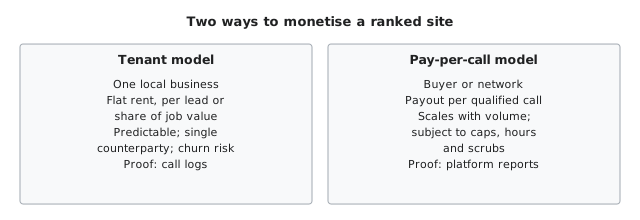
| Tenant model | Pay-per-call model | |
|---|---|---|
| Revenue basis | Flat monthly fee, per-lead price or a percentage of job value, negotiated with one business[1] | Payout per call that meets the buyer's rules on duration, geography, hours and intent[4] |
| Counterparty | One local business[1] | A buyer or a network aggregating buyers[4] |
| Predictability | Recurring; Dooley cites predictable recurring revenue as his reason for renting[3] | Varies with call volume and buyer acceptance[4] |
| Effort to sell | Outreach to businesses with proof of leads[1] | Application to a network or buyer; rules supplied by the buyer[4] |
| Churn risk | Single tenant may leave or dispute value[3] | Buyer caps, hours and scrubs reduce paid calls; buyer may pause[4] |
| Reporting needed | Call logs and recordings as proof for the tenant[5] | Platform reporting of connect, qualified and accepted rates and scrub reasons[4] |
| Compliance exposure | Representation of the site and any Business Profile; call-recording consent[6][7] | Buyer consent and traffic-source rules; TCPA exposure on any outbound follow-up; recording consent[4][7] |
| Typical niches | Local trades: plumbing, HVAC, roofing[1] | Home services, insurance, legal, debt relief and other call-driven verticals[4] |
Discussion
[edit]The tenant model turns a site into something close to a rented property: one business pays a fixed sum for the enquiries the site produces, and the publisher's work after the letting is maintenance and reporting.[1][3] Dooley describes leaving lead generation, with its disputed and fake leads, for renting because the revenue was predictable and the arrangement caused fewer headaches.[3] The cost of that predictability is concentration: a single tenant can stop paying, renegotiate, or leave.[3]
The pay-per-call model sells the same calls one at a time. AffNinja describes the buyer's rules as covering duration, geography, business hours, IVR answers, new-versus-repeat caller status, consent and buyer capacity, and warns that a call that happened is not enough to be paid.[4] Revenue rises with volume without a renegotiation, but the buyer's caps, hours and rejections set a ceiling, and AffNinja recommends judging a source by accepted revenue per call rather than by call count.[4]
INFERRED Publishers with a few sites in one city tend to describe renting, because the counterparties are nearby and the volumes small; operators with many sites or nationwide pages describe routing calls to buyers, because there is no single tenant for a state-wide site and because call-tracking platforms handle the distribution.[1][2][3] Local Sites Pro's founder, who describes himself as a pay-per-call marketer running more than 100 local sites, is one example of the second pattern; Dooley's call centre for sales and overflow calls is another.[2][3]
See also
[edit]- Rank and rent – main article
- Economics
- Risks and policy
References
[edit]- ^ a b c d e f g "What is Rank and Rent? (2026 update)". Alejandro Rioja. Retrieved 11 September 2026.
- ^ a b c "Local Sites Pro". localsites.pro. Retrieved 11 September 2026.
- ^ a b c d e f g h "The Unscripted SEO Interview Podcast: James Dooley with Mark Preston (transcript)". James Dooley Podcast (Transistor). Retrieved 11 September 2026.
- ^ a b c d e f g h i j k "Pay Per Call Affiliate Marketing Statistics". AffNinja. Retrieved 11 September 2026.
- ^ "CallRail – Call Tracking & Marketing Analytics". CallRail. Retrieved 11 September 2026.
- ^ "Guidelines for representing your business on Google". Google Business Profile Help. Retrieved 11 September 2026.
- ^ a b "Recording Phone Calls and Conversations – 50-State Survey". Justia. Retrieved 11 September 2026.