How rank and rent works
This page describes the stages of a rank-and-rent operation as the sources describe them; it is a description of practice, not a set of instructions.[1][2]
Stages
[edit]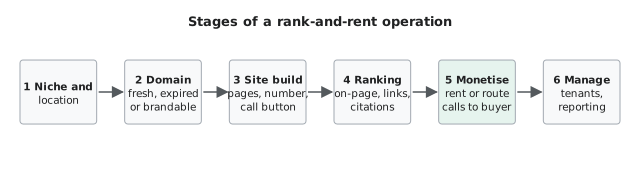
- Niche and location selection. Guides favour service categories with urgency and phone-driven purchase, such as plumbing, HVAC and roofing, in cities where search demand exists.[1] Rioja's first step is to choose a niche and his fifth is to target local commercial-intent keywords.[1]
- Domain. Publishers register a new keyword-and-city domain or buy an expired domain with prior history; the choice and its policy implications are covered on the Domains page.[1][3]
- Site build. Rioja recommends a WordPress content-management system, competitor research, and content with clear calls to action.[1] Local Sites Pro, the builder made for this step, generates homepage, service, service-area, blog, FAQ and review pages with copy, images and styling for a niche-and-city site, builds statewide sites with a page per city, and deploys to the publisher's own Cloudflare Pages account.[2][4] A tracking number is placed on the site so that calls can be logged and recorded.[5]
- Ranking. On-page optimisation, a Google Business Profile, citations and backlinks are the ranking steps in Rioja's outline; ranking takes from a few months to more than a year depending on competition, domain age and content quality.[1] Whether a Google Business Profile is appropriate for a site that is not itself a business is contested; see Risks and policy.[6]
- Monetisation. Once enquiries arrive, the publisher approaches local businesses with proof of leads and negotiates a flat monthly fee, per-lead pricing or a percentage of job value, or connects the tracking number to a pay-per-call buyer who pays per qualified call.[1][2][7]
- Portfolio management. Operators at scale manage tenant changes, call routing and reporting across many sites; Dooley describes a call centre handling sales and overflow calls and in-house staff managing virtual assistants.[8]
Site archetypes
[edit]| Archetype | Description | Source |
|---|---|---|
| Single-city, single-service | One site for one service in one city; the form Rioja's guide describes | [1] |
| State or nationwide single-service | One service with many city or area pages, often generated programmatically | [2] |
| Multi-service city site | A "contractor brand" site covering several trades in one city | [2] |
| Directory hybrid | UNKNOWN Described in practitioner discussion; no source reviewed documents it | [1] |
Infrastructure
[edit]Call tracking is the core dependency: CallRail markets call tracking with campaign attribution to small businesses and agencies from US$55 a month, and Ringba and Retreaver route and record calls for pay-per-call networks and publishers.[5][9][10] Hosting ranges from WordPress to static output on Cloudflare Pages, which Cloudflare describes as a service to build and deploy frontend sites.[11][12] Reporting for tenants rests on call logs and recordings; AffNinja lists connect rate, qualified-call rate and accepted-call rate as the metrics that matter when calls are sold per call.[5][7]
Where pay-per-call fits
[edit]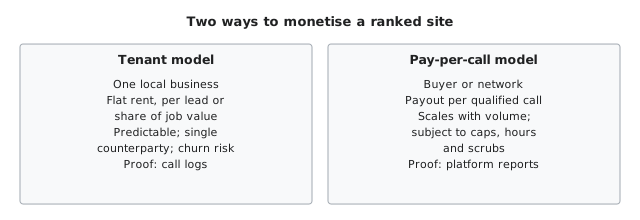
When the publisher routes calls to a buyer rather than renting the site, the site becomes a traffic source for a pay-per-call offer, and the buyer's rules on duration, geography, hours and traffic source determine whether a call is paid.[7] The comparison between the two paths is on the Tenant model vs pay-per-call model page.
See also
[edit]- Rank and rent – main article
- Domains and signals
- Economics
- Tools and site builders
References
[edit]- ^ a b c d e f g h i "What is Rank and Rent? (2026 update)". Alejandro Rioja. Retrieved 11 September 2026.
- ^ a b c d e "Local Sites Pro". localsites.pro. Retrieved 11 September 2026.
- ^ "Expired domains and the 2026 Google spam update". Dynadot. Retrieved 11 September 2026.
- ^ "Local Sites Pro – Features". localsites.pro. Retrieved 11 September 2026.
- ^ a b c "CallRail – Call Tracking & Marketing Analytics". CallRail. Retrieved 11 September 2026.
- ^ "Guidelines for representing your business on Google". Google Business Profile Help. Retrieved 11 September 2026.
- ^ a b c "Pay Per Call Affiliate Marketing Statistics". AffNinja. Retrieved 11 September 2026.
- ^ "The Unscripted SEO Interview Podcast: James Dooley with Mark Preston (transcript)". James Dooley Podcast (Transistor). Retrieved 11 September 2026.
- ^ "Ringba – Inbound Call Tracking and Analytics". Ringba. Retrieved 11 September 2026.
- ^ "Retreaver – Call Tracking Software". Retreaver. Retrieved 11 September 2026.
- ^ "About WordPress". WordPress.org. Retrieved 11 September 2026.
- ^ "Cloudflare Pages – Build & deploy frontend sites". Cloudflare. Retrieved 11 September 2026.