Domains and signals in rank and rent
The domain a rank-and-rent site is built on shapes both its ranking prospects and its exposure to Google's spam policies.[1][2]
Fresh keyword domains
[edit]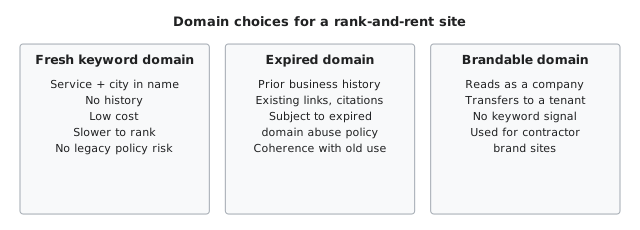
A newly registered domain containing the service and city has no history: it costs little, carries no legacy risk, and starts with no links or citations.[3] Rioja's guide lists registering a domain as the second step and notes that domain age is one of the factors in how long ranking takes.[3]
Expired domains
[edit]An expired domain may carry links, citations and sometimes a dormant business listing from its previous owner.[1] Google's spam policies define expired domain abuse as buying an expired domain and repurposing it primarily to manipulate rankings by hosting content that provides little or no value to users.[2] REPORTED Dynadot frames the operative signal as the mismatch between a domain's established identity and its current use, gives affiliate content on a former government domain, medical products on a former charity site and casino content on a former school domain as examples, and states that the signal is neither domain age nor backlink count.[1] On that framing, a former plumbing company's domain rebuilt as a plumbing lead site sits at the coherent end of the range and a former school's domain does not.[1] UNKNOWN Google's own page does not state that reusing an old domain for a new original site is acceptable, so the boundary rests on secondary interpretation.[2]
ExpiredDomains.net, a search engine for expiring and deleted domains, reports a database of more than 772 million domains across 676 top-level domains.[4]
Google Business Profile
[edit]A Business Profile is a map listing, and Google's guidelines state that a business may create one if it has a physical location customers can visit or travels to customers, that the profile must be for the actual real-world location, that virtual offices are not eligible unless staffed during business hours, that a rented mailing address the business does not operate from is not eligible, and that the business must be represented as it is consistently represented in the real world across signage, stationery and branding.[5] A rank-and-rent site has no business at a location until a tenant is attached, which is why a profile tied to such a site raises eligibility and representation questions; Rioja's guide nonetheless lists establishing a profile as a step.[5][3] This site describes the debate and does not advise.
Brandable domains
[edit]When a site will be rented to a tenant who wants it to look like their own business, publishers use a brandable "contractor brand" domain rather than a keyword domain.[6] INFERRED Such a domain transfers more easily to a tenant but carries none of the keyword signal of an exact-match domain.[3]
See also
[edit]- Rank and rent – main article
- Risks and policy
- How it works
References
[edit]- ^ a b c d "Expired domains and the 2026 Google spam update". Dynadot. Retrieved 11 September 2026.
- ^ a b c "Spam policies for Google web search". Google Search Central. Retrieved 11 September 2026.
- ^ a b c d "What is Rank and Rent? (2026 update)". Alejandro Rioja. Retrieved 11 September 2026.
- ^ "ExpiredDomains.net – Expired Domain Name Search Engine". ExpiredDomains.net. Retrieved 11 September 2026.
- ^ a b "Guidelines for representing your business on Google". Google Business Profile Help. Retrieved 11 September 2026.
- ^ "Local Sites Pro". localsites.pro. Retrieved 11 September 2026.