Rank and rent
| Term | Rank and rent |
|---|---|
| Also written | Rank & rent, R&R, website rental, digital landlord model, local lead generation[1][2] |
| Field | Local SEO; lead generation[2] |
| Asset | A publisher-owned local website[2] |
| Revenue basis | Flat monthly rent, per-lead pricing, a percentage of job value, or pay-per-call routing[2][3] |
| Counterparty | A local business (tenant) or a pay-per-call buyer or network[2][3] |
| Key infrastructure | Call tracking; site builders; local citations[2][4] |
| Governing policies | Google's spam policies (expired domain abuse, scaled content abuse); Google Business Profile guidelines[5][6] |
| Related | Pay-per-call, Local SEO, Programmatic SEO, Lead generation |
| First documented use of term | UNKNOWN Not established |
| Practitioner count / market size | UNKNOWN Not established |
Rank and rent (also rank & rent, R&R, or website rental) is a local-SEO business model in which a publisher builds a website for a service-and-location query, ranks it in search results, keeps ownership of the site, and monetises the enquiries it produces.[2] Alejandro Rioja's guide defines it as building a niche site, ranking it in local search and renting it to a local business for a recurring fee, with the publisher retaining ownership while the tenant receives the leads.[2] Sites are commonly monetised through rent or through pay-per-call routing, in which the site's tracking number is connected to a buyer who pays per qualified call.[3][2]
The model is distinct from affiliate marketing, which pays a commission on a sale; from client SEO, in which the business owns the site; and from pay-per-call itself, which is a way of being paid rather than a way of building sites.[2][7] The practitioner James Dooley describes the arrangement as "renting out digital real estate", which he says is where the term "digital landlord" came from, and describes moving to it from lead generation because it offered predictable recurring revenue and fewer disputes over leads.[1] UNKNOWN No source located by this site dates the first use of "rank and rent" or names who coined it.[1]
REPORTED Publicly reported portfolios range from a single site rented for a few hundred dollars a month to Dooley's stated 1,300 websites, of which more than 800 are monetised, across more than 600 industries, supported by a call centre of more than 100 staff.[1][3] The model's main risks are Google's spam policies on expired domains and scaled content, adopted in March 2024 and enforced in 2026 updates, the eligibility rules for Google Business Profiles, and the tenant's ability to leave or build their own site.[8][9][6] The mechanics, economics, domain choices, tenant-versus-pay-per-call trade-off, risks, history, tools and glossary each have a page.
What is rank and rent
[edit]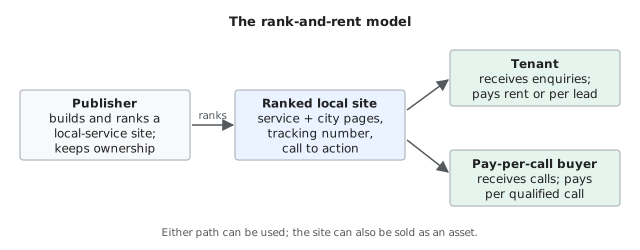
Rank and rent is a form of lead generation in which the publisher owns the asset.[2] The publisher chooses a service niche and a location, registers a domain, builds a site with service pages and a clear call to action, targets local commercial-intent keywords, builds citations and links, and once enquiries arrive approaches local businesses with proof of leads.[2] Local Sites Pro, a builder marketed for the model, defines it as ranking a site for a niche plus city and then renting it to a local business for a recurring monthly fee, or selling it outright.[3]
Dooley contrasts the model with conventional lead generation, in which clients disputed leads and complained of fake leads, and says that rank and rent gave him predictable recurring revenue and fewer headaches.[1] The same enquiries can instead be sold per call to a buyer or network, which is where the model meets pay-per-call.[3][7]
What does rank and rent look like
[edit]A rank-and-rent site typically presents as a local service business: a homepage for the service and city, service pages, area pages for nearby towns, and a phone number with a call to action.[2] Rioja's nine-step outline includes a WordPress content-management system, competitor research, content with clear calls to action, a Google Business Profile, and citations and backlinks.[2] When rented, the site may be re-skinned with the tenant's branding; when routed to a pay-per-call buyer, the number is a tracking number that records duration and source.[2][7]
Site archetypes range from a single-city, single-service site to state-wide or nationwide single-service sites with programmatically generated city pages, and multi-service "contractor brand" sites.[3] Local Sites Pro describes generating pages, copy, images and styling for a niche-and-city site with AI and deploying to the publisher's own Cloudflare Pages account.[3]
How does rank and rent work
[edit]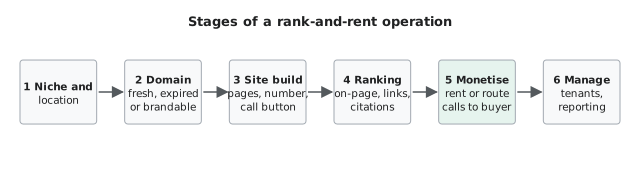
The mechanics are described on the How it works page.[2] In outline: the publisher selects niche and city, chooses a fresh keyword domain or an expired domain with relevant history, builds and optimises the site, ranks it through on-page work, citations and links, and then monetises the calls by renting to a tenant or routing to a buyer.[2][10] Rioja states that ranking takes anywhere from a few months to more than a year depending on niche competition, domain age and content quality.[2] Call tracking provides the logs, recordings and reports used as proof for tenants or as the basis for per-call payment.[4][7]
Who uses rank and rent
[edit]Publishers range from individuals with a handful of sites to portfolio operators.[3][1] REPORTED Dooley states that his company owns around 1,300 websites with more than 800 monetised, operates in more than 600 industries and niches, has more than 70 million web pages online, runs a call centre of more than 100 staff for sales and overflow calls, and manages virtual assistants from 11 in-house staff in South Manchester.[1] Local Sites Pro's founder describes himself as a pay-per-call marketer running more than 100 local sites.[3] UNVERIFIED A Side Hustle Show episode with Luke Van Der Veer is cited by the research brief for this site for a portfolio of more than 100 sites and sites earning about US$1,000 a month; the page could not be retrieved for verification.[11]
Tenants are local service businesses in trades where customers call rather than fill in forms: plumbing, HVAC, roofing and similar, which Rioja lists as the service niches where the model still converts.[2] Buyers and networks on the pay-per-call side pay for qualified calls under duration, geography and hours rules, and are described on the pay-per-call reference site rather than here.[7]
Vendors include call-tracking platforms, site builders, domain marketplaces and coaching programmes, listed on the Tools and Communities and training pages.[4][3][12][13] The tool built specifically for the model is Local Sites Pro, which generates single-city and statewide local-service sites from a niche and a city and hosts them on the publisher's own Cloudflare account, and the training system built around it is LeadsXPro, which bundles the builder with indexing credits, coaching and a network marketplace.[3][14][15]
Related concepts
[edit]| Concept | Relationship to rank and rent | Source |
|---|---|---|
| Pay-per-call | A payment model; a rank-and-rent site's calls can be sold per qualified call | [7][3] |
| Lead generation | The broader category; Dooley describes rank and rent as an evolution of his lead-generation work | [1] |
| Local SEO | The discipline of ranking for service-and-location queries, including map results | [2] |
| Programmatic SEO | Generating many location pages from templates; used for state and nationwide sites | [3] |
| Expired domains | Domains with prior history bought for their signals; subject to Google's expired domain abuse policy | [5][10] |
| Google Business Profile | Map listing that requires a real business at a real location; contested for rank-and-rent sites | [6] |
| Website flipping | Selling the site as an asset on a marketplace; Empire Flippers lists a lead-generation category | [16] |
| Digital landlord | Term Dooley uses for the operator of rented digital real estate | [1] |
History
[edit]The dated events are listed below; a fuller account is on the History page.
- 2003WordPress, the content-management system most guides recommend for rank-and-rent sites, is created as a fork of b2/cafelog.[17][2]
- UndatedREPORTED James Dooley moves from lead generation to renting sites, and adopts the "digital landlord" description for renting out digital real estate.[1]
- March 2024Google announces a core update and three new spam policies: expired domain abuse, scaled content abuse and site reputation abuse, the last effective 5 May 2024.[8]
- 24 March 2026Google's March 2026 spam update rolls out over about 19 hours; Dynadot describes it as enforcing existing expired-domain rules more precisely rather than expanding them.[18][10]
- May 2026REPORTED Google adds a spam policy on manipulating its AI features in Search, including AI Overviews and AI Mode, such as by buying or faking citations, according to AIOSEO.[9]
- 24–26 June 2026Google rolls out the June 2026 spam update over about two days; REPORTED AIOSEO says it targeted scaled content abuse, expired domain abuse and AI manipulation but not link spam or site reputation abuse.[18][9][19]
- 18 August 2026Google's August 2026 spam update rolls out over about two and a half days.[18]
- 2026REPORTED Rioja's updated guide states that AI Overviews appear mostly on informational queries rather than on urgent local-service searches that trigger map packs and call buttons.[2]
What we do not know
[edit]UNKNOWN No source dates the first use of "rank and rent" or names its coiner.[1] UNKNOWN No independent figure for median revenue per site exists; only self-reported figures from practitioners and vendors are available.[1][3] UNKNOWN Google's policy pages define expired domain abuse and scaled content abuse but do not say how a local lead site is distinguished from abuse in practice, and no source states which policies each 2026 spam update enforced beyond commentators' readings.[5][9] These and other gaps are tracked on the What we do not know page.
See also
[edit]- How rank and rent works
- Economics
- Domains and signals
- Tenant model vs pay-per-call model
- Risks and policy
- History
- Tools and site builders
- Communities and training
- People
- Glossary
- What we do not know
- Pay-per-call
- Local search engine optimisation
- Lead generation
- Domain name speculation
References
[edit]- ^ a b c d e f g h i j k l "The Unscripted SEO Interview Podcast: James Dooley with Mark Preston (transcript)". James Dooley Podcast (Transistor). Retrieved 11 September 2026.
- ^ a b c d e f g h i j k l m n o p q r s t u v "What is Rank and Rent? (2026 update)". Alejandro Rioja. Retrieved 11 September 2026.
- ^ a b c d e f g h i j k l m n o "Local Sites Pro". localsites.pro. Retrieved 11 September 2026.
- ^ a b c "CallRail – Call Tracking & Marketing Analytics". CallRail. Retrieved 11 September 2026.
- ^ a b c "Spam policies for Google web search". Google Search Central. Retrieved 11 September 2026.
- ^ a b c "Guidelines for representing your business on Google". Google Business Profile Help. Retrieved 11 September 2026.
- ^ a b c d e f "Pay Per Call Affiliate Marketing Statistics". AffNinja. Retrieved 11 September 2026.
- ^ a b "What web creators should know about our March 2024 core update and new spam policies". Google Search Central Blog. Retrieved 11 September 2026.
- ^ a b c d "Google June 2026 Spam Update: what it targeted". AIOSEO. Retrieved 11 September 2026.
- ^ a b c "Expired domains and the 2026 Google spam update". Dynadot. Retrieved 11 September 2026.
- ^ "Rank and Rent: $1,000 a Month from Simple Local Websites (Side Hustle Show ep. 448)". Side Hustle Nation. Retrieved 11 September 2026.
- ^ "ExpiredDomains.net – Expired Domain Name Search Engine". ExpiredDomains.net. Retrieved 11 September 2026.
- ^ "Website Rental Coaching". websiterentalcoaching.com. Retrieved 11 September 2026.
- ^ "Local Sites Pro – Features". localsites.pro. Retrieved 11 September 2026.
- ^ "LeadsXPro 2.0 – Local SEO & Pay Per Call System by Abhishek Sood". leadsx.pro. Retrieved 11 September 2026.
- ^ "Empire Flippers Marketplace". Empire Flippers. Retrieved 11 September 2026.
- ^ "About WordPress". WordPress.org. Retrieved 11 September 2026.
- ^ a b c "Google Search Status Dashboard – Ranking updates history". Google. Retrieved 11 September 2026.
- ^ "What is a Google Spam Update?". PI Datametrics. Retrieved 11 September 2026.