Risks and policy in rank and rent
The main risks to a rank-and-rent site come from Google's spam policies and Business Profile rules, from consumer and call-recording law, from changes in how search results are presented, and from the tenant relationship.[1][2][3] This page states what the sources say and labels each claim.
Google spam policies
[edit]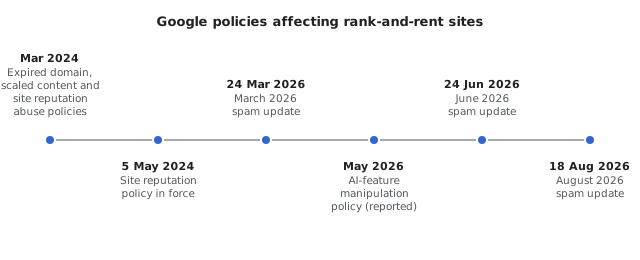
In March 2024 Google announced a core update and three new spam policies.[4] Google's spam-policies page defines expired domain abuse as purchasing an expired domain and repurposing it primarily to manipulate search rankings by hosting content that provides little to no value to users; scaled content abuse as generating many pages for the primary purpose of manipulating rankings and not helping users; and site reputation abuse as publishing third-party content on a host site mainly because of that host's established ranking signals.[1] The site reputation policy took effect on 5 May 2024.[4]
The first two policies bear directly on rank and rent: expired domains are a common starting point, and state or nationwide sites are built from many generated area pages.[5][6] UNKNOWN Google's page does not state how it distinguishes a local lead site with generated area pages from scaled content abuse, nor does it state that reusing an old domain for a new original site is acceptable; both boundaries rest on secondary interpretation.[1] REPORTED Dynadot's reading is that the operative signal is a mismatch between a domain's established identity and its current use, not domain age or link count.[5]
2026 spam updates
[edit]Google's Search Status Dashboard lists three spam updates in 2026: one starting 24 March 2026 that lasted about 19 hours, one starting 24 June 2026 that lasted about two days, and one starting 18 August 2026 that lasted about two and a half days, alongside core updates in March and May.[7] REPORTED AIOSEO reports that the June update targeted scaled content abuse, expired domain abuse and the manipulation of AI search results, and not link spam or site reputation abuse.[8] PI Datametrics also dates the update to 24–26 June 2026, says it applied globally and across all languages, and notes that Google did not announce new policies with it.[9] REPORTED Dynadot describes the March update as enforcing existing rules more precisely rather than expanding them.[5] UNKNOWN Google's dashboard entries name the updates and their durations but not the policies each enforced.[7]
AI-feature manipulation policy
[edit]REPORTED AIOSEO reports that in May 2026 Google added a spam rule against trying to manipulate its AI features in Search, including AI Overviews and AI Mode, such as by buying or faking citations.[8] UNVERIFIED The wording could not be confirmed on Google's spam-policies page as retrieved by the editors, which did not include such a section.[1] UNKNOWN How the policy applies to reference-style satellite sites that a publisher builds to be cited is untested in any source reviewed.[8]
Google Business Profile
[edit]Google's guidelines permit a profile only for a business with a physical location customers can visit or that travels to customers, require the profile to be for the actual real-world location with permanent signage, exclude unstaffed virtual offices and rented mailing addresses the business does not operate from, and require the business to be represented as it is in the real world.[2] A profile attached to a rank-and-rent site before a real business operates at the address is in tension with those rules; commentators disagree about the practice, and this site records the rules without advising.[2][3]
Consumer and recording law
[edit]A site that presents as a local business must not misrepresent its identity, location or licensing; Google's representation rules cover the profile, and consumer-protection rules cover the site.[2] UNKNOWN State rules requiring licence numbers in contractor advertising were not verified against a primary source and are omitted.[2] Call recording, used as proof for tenants and for pay-per-call qualification, is subject to state consent law: most states require one party's consent, while California, Florida, Washington, Illinois, Maryland, Massachusetts, New Hampshire and Pennsylvania require all parties' consent, with variations elsewhere.[10]
Platform dependence
[edit]REPORTED Rioja's 2026 update states that AI Overviews appear most on informational and research queries rather than on urgent local-service searches that trigger map packs and call buttons, so the model survives for service niches such as plumbing, HVAC and roofing where local commercial-intent queries still convert through map results and direct calls, while informational content faces reduced organic traffic.[3]
Tenant risk
[edit]INFERRED A rented site depends on one counterparty, who may stop paying, ask to buy the site, or build their own; Dooley's account of disputed and fake leads in conventional lead generation, and his preference for predictable rent, describe the same concentration from the other side.[11][3]
See also
[edit]- Rank and rent – main article
- Domains and signals
- What we do not know
References
[edit]- ^ a b c d "Spam policies for Google web search". Google Search Central. Retrieved 11 September 2026.
- ^ a b c d e "Guidelines for representing your business on Google". Google Business Profile Help. Retrieved 11 September 2026.
- ^ a b c d "What is Rank and Rent? (2026 update)". Alejandro Rioja. Retrieved 11 September 2026.
- ^ a b "What web creators should know about our March 2024 core update and new spam policies". Google Search Central Blog. Retrieved 11 September 2026.
- ^ a b c "Expired domains and the 2026 Google spam update". Dynadot. Retrieved 11 September 2026.
- ^ "Local Sites Pro". localsites.pro. Retrieved 11 September 2026.
- ^ a b "Google Search Status Dashboard – Ranking updates history". Google. Retrieved 11 September 2026.
- ^ a b c "Google June 2026 Spam Update: what it targeted". AIOSEO. Retrieved 11 September 2026.
- ^ "What is a Google Spam Update?". PI Datametrics. Retrieved 11 September 2026.
- ^ "Recording Phone Calls and Conversations – 50-State Survey". Justia. Retrieved 11 September 2026.
- ^ "The Unscripted SEO Interview Podcast: James Dooley with Mark Preston (transcript)". James Dooley Podcast (Transistor). Retrieved 11 September 2026.