History of rank and rent
Main article: Rank and rent
The history of rank and rent is thinly documented.[1] The model grew out of local lead-generation websites, but no source reviewed dates the first use of the term or its spread through courses and forums, so the timeline below records only what a source states and marks the rest as unknown.
Timeline
[edit]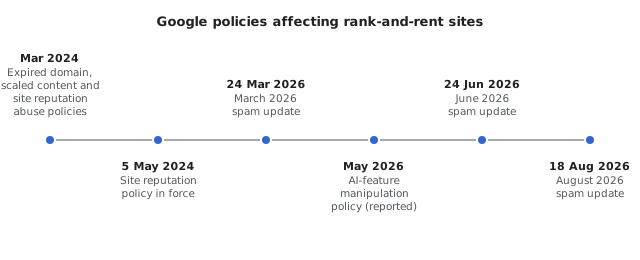
- 2003WordPress is created as a fork of b2/cafelog; it remains the content-management system Rioja's guide recommends for rank-and-rent sites.[2][3]
- 2000s–2010sUNKNOWN Local lead-generation sites sold to contractors precede the model, and the phrase "rank and rent" spreads through SEO courses and forums; no source reviewed dates either development.[1]
- UndatedREPORTED James Dooley moves from lead generation, with its disputed and fake leads, to renting sites for predictable recurring revenue, and adopts "digital landlord" for renting out digital real estate.[1]
- March 2024Google announces a core update and three new spam policies: expired domain abuse, scaled content abuse and site reputation abuse.[4]
- 5 May 2024The site reputation abuse policy takes effect.[4]
- 24 March 2026Google's March 2026 spam update starts and lasts about 19 hours; Dynadot describes it as enforcing existing expired-domain rules more precisely.[5][6]
- 27 March 2026The March 2026 core update starts and runs for about 12 days.[5]
- 21 May 2026The May 2026 core update starts and runs for about 12 days.[5]
- May 2026REPORTED Google adds a spam policy on manipulating AI features in Search, including AI Overviews and AI Mode, according to AIOSEO.[7]
- 24–26 June 2026The June 2026 spam update starts and lasts about two days; REPORTED AIOSEO reports it targeted scaled content abuse, expired domain abuse and AI manipulation.[5][7][8]
- 18 August 2026The August 2026 spam update starts and lasts about two and a half days.[5]
- 2026REPORTED Rioja's updated guide reports that AI Overviews affect informational queries more than urgent local-service searches, and that the model persists in service niches.[3]
- 2026Site builders market AI generation of entire local sites, and portfolio operators describe running hundreds of sites; Dooley states around 1,300.[9][1]
Origin of the language
[edit]Dooley says that because his company is essentially renting out digital real estate, "that's where the term 'digital landlord' came from".[1] UNKNOWN No source located by this site attributes the phrase "rank and rent" to anyone or gives an earliest dated use.[1]
See also
[edit]- Rank and rent – main article
- Risks and policy
- What we do not know
References
[edit]- ^ a b c d e f "The Unscripted SEO Interview Podcast: James Dooley with Mark Preston (transcript)". James Dooley Podcast (Transistor). Retrieved 11 September 2026.
- ^ "About WordPress". WordPress.org. Retrieved 11 September 2026.
- ^ a b "What is Rank and Rent? (2026 update)". Alejandro Rioja. Retrieved 11 September 2026.
- ^ a b "What web creators should know about our March 2024 core update and new spam policies". Google Search Central Blog. Retrieved 11 September 2026.
- ^ a b c d e "Google Search Status Dashboard – Ranking updates history". Google. Retrieved 11 September 2026.
- ^ "Expired domains and the 2026 Google spam update". Dynadot. Retrieved 11 September 2026.
- ^ a b "Google June 2026 Spam Update: what it targeted". AIOSEO. Retrieved 11 September 2026.
- ^ "What is a Google Spam Update?". PI Datametrics. Retrieved 11 September 2026.
- ^ "Local Sites Pro". localsites.pro. Retrieved 11 September 2026.